

Chemical Weather Observations of Carbon Chemistry in the Greater Bay Area
Theme-based Research Scheme Project (No. T24-614/25-N)
CACHE-GBA (CArbon CHEmistry - the Greater Bay Area)
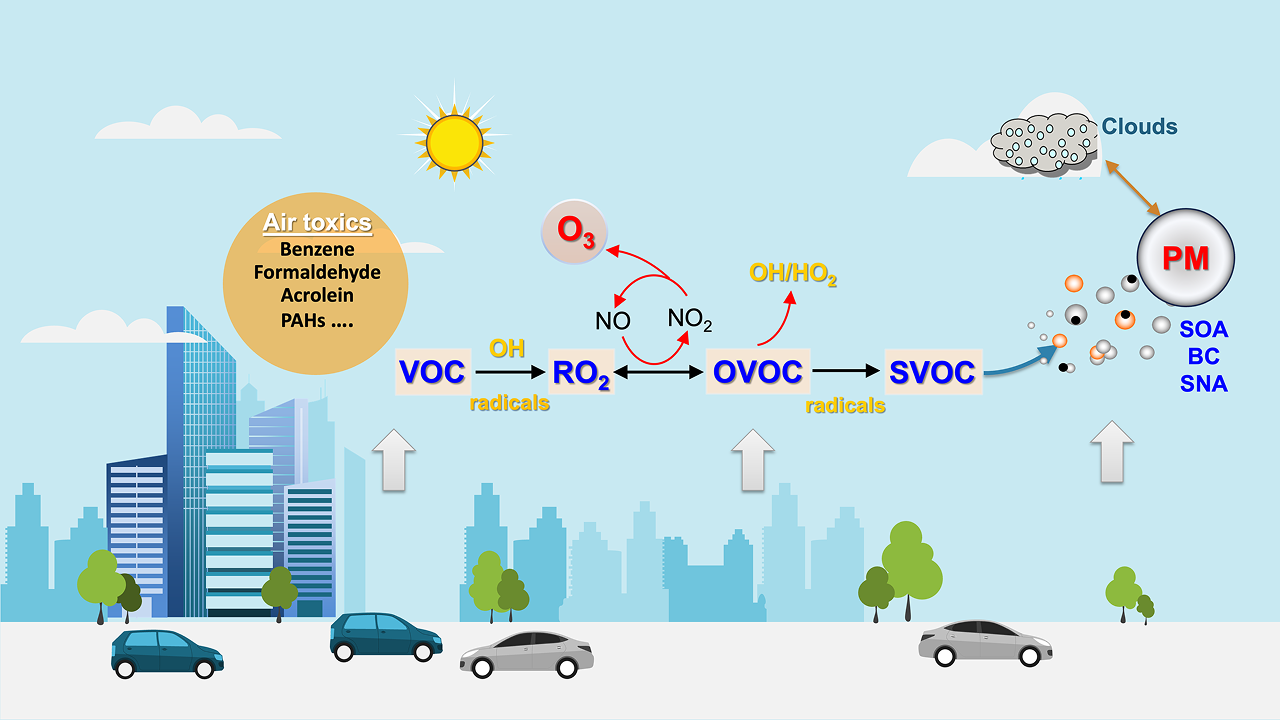
Motivations and Study Goal
This study aims to establish China’s first comprehensive chemical weather monitoring network in the Greater Bay Area (GBA), focusing on real-time tracking of carbon chemistry (CC) and key air pollutants. Conventional weather monitoring only tracks the physical conditions of the atmosphere such as temperature and wind. Observation of chemical weather—dynamic changes in pollutants such as volatile organic compounds and toxic compounds—is essential in providing early warnings during extreme air pollution events and guiding policies protecting public health, agriculture, and ecosystems. Currently, most organic compounds are measured only in short-term campaigns. This project addresses this gap by delivering long-term, high-resolution data on both total and speciated carbon. The resulting data will provide essential insights into pollution sources, formation pathways, and health impacts. By integrating chemical weather monitoring with advanced modelling, this initiative ensures a more complete understanding of air pollution dynamics, ultimately aiding sustainable development and costeffective health protection policies.
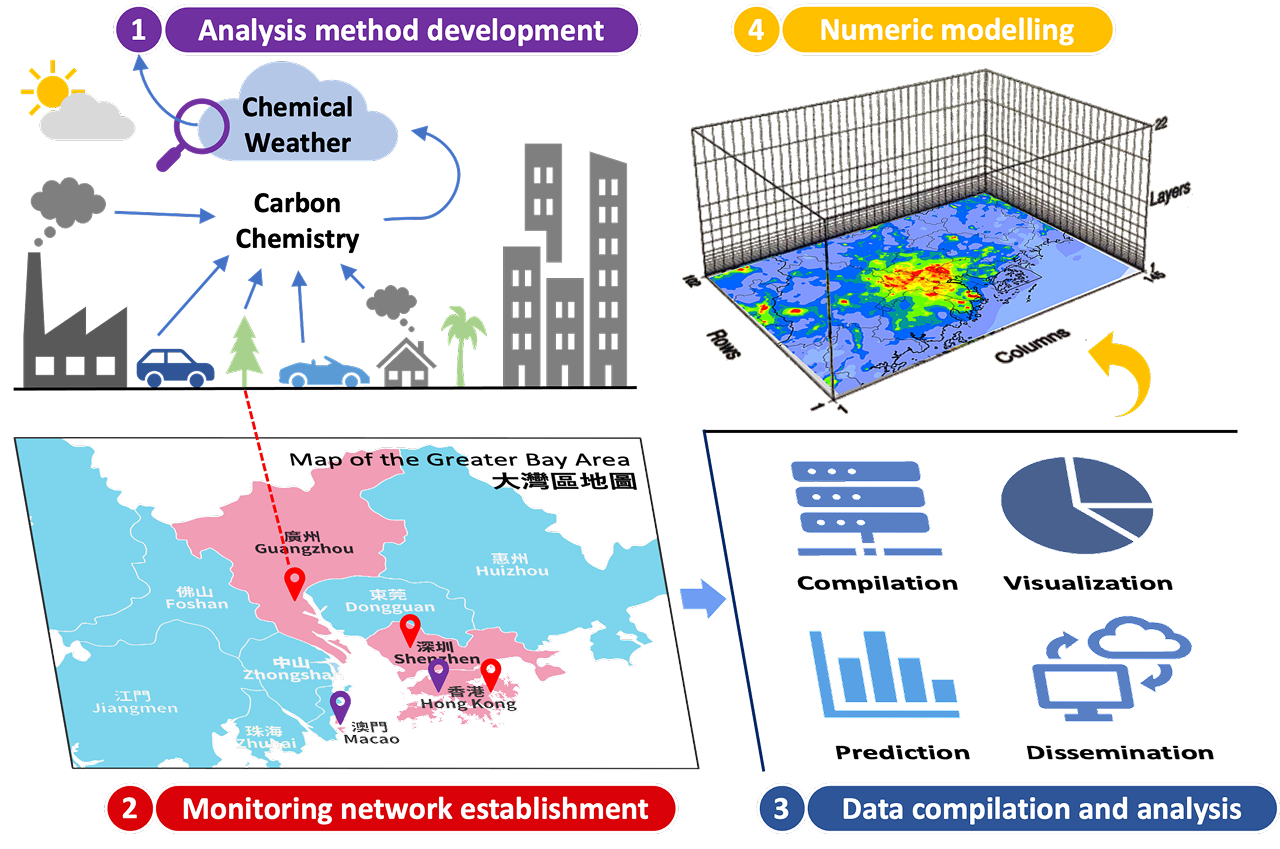
Four Working Packages
- Analysis method development: to explore and test a set of different analytical instruments for CC species of various states; to formulate standard operating procedures.
- Monitoring network establishment: to deploy sets of instruments at five monitoring stations in the GBA; to prepare standard calibration and personnel training programs.
- Data compilation and analysis: to cleanse and unify data from monitoring network, satellite measurement and numeric models; to develop new statistical methods to distill new insight; to create online platform for public and research-related access.
- Numeric modelling: to assimilate high-resolution measurement data to regional air quality models for enhanced performance; to predict episodic events and short-term scenarios; to generate gridded data for evaluations of the epidemiological, ecological, and economic impacts.
Project Team
A strong, multidisciplinary team, with deep expertise in atmospheric chemistry, air quality monitoring and modelling, includes co-PIs (12) and co-Is (6) from four local universities, the HKEPD, key institutions across the GBA, and oversea collaborators (8) from Georgia Tech, the University of Helsinki, and leading research institutes in Mainland China. Most team members have already been collaborating closely in past or on-going projects.
Deliverables
-
Tools and platform: a standard measurement protocol to achieve comprehensive observation of carbon chemistry species for various data needs; an organized database to visualize and disseminate data products from chemical weather observations of carbon chemistry in the GBA; an integrated modelling method to incorporate carbon chemistry observations to regional air quality model for improved accuracy; a training framework for young researchers and engineers.
- Knowledge: an updated understanding of ambient carbon chemistry species in the GBA with rich spatial and temporal details; a projection of future pollution scenarios with higher credibility.
- Solution: policy recommendations for reducing air pollution via regulating pivotal carbon chemistryrelated emission sources, while closely evaluating effects through the monitoring network.