

A recent study (Chen et al., 2026) published in Environmental Science & Technology (ES&T) by Prof. Jian Zhen Yu's research group at The Hong Kong University of Science and Technology proposes a "Quasi-Michaelis–Menten" kinetics mechanism to solve the long-standing puzzle of the nonlinear concentration-response relationship in the Dithiothreitol assay. Building upon the team's prior breakthroughs in Ascorbic Acid and Glutathione assays, this work completes a unified biochemical kinetics framework that explains the chemical mechanics behind the three main acellular oxidative potential measurement methods for atmospheric particulate matter (PM2.5).
Oxidative potential (OP) serves as a critical proxy for evaluating PM-induced oxidative stress and adverse health impacts, with the Dithiothreitol (DTT) assay being the most widely adopted method. However, researchers frequently encounter a nonlinear response curve: doubling the sample or metal concentration yields significantly less than a two-fold increase in measured OP. This nonlinear behavior causes mass-normalized OP (OPm) to vary drastically with sample dilution (e.g., an 8-fold dilution can artificially inflate OPm by over 200%), severely confounding toxicity comparisons and receptor modeling based on linear assumptions. Having successfully introduced the Quasi-MM mechanism to the Ascorbic Acid (AA) and Glutathione (GSH) assays, Prof. Yu's team extended this biochemical kinetic approach to the DTT assay. The objective of this study is to resolve the challenges associated with metal-metal interactions and nonlinear OP predictions in real-world ambient PM samples.
Research Highlights
1. Quasi-Michaelis–Menten Kinetics in DTT Assay
To capture saturation-like kinetic behavior in the DTT assay, the team formulated the Quasi-Michaelis–Menten mechanism, drawing an analogy between enzymatic catalysis and metal-catalyzed DTT oxidation.
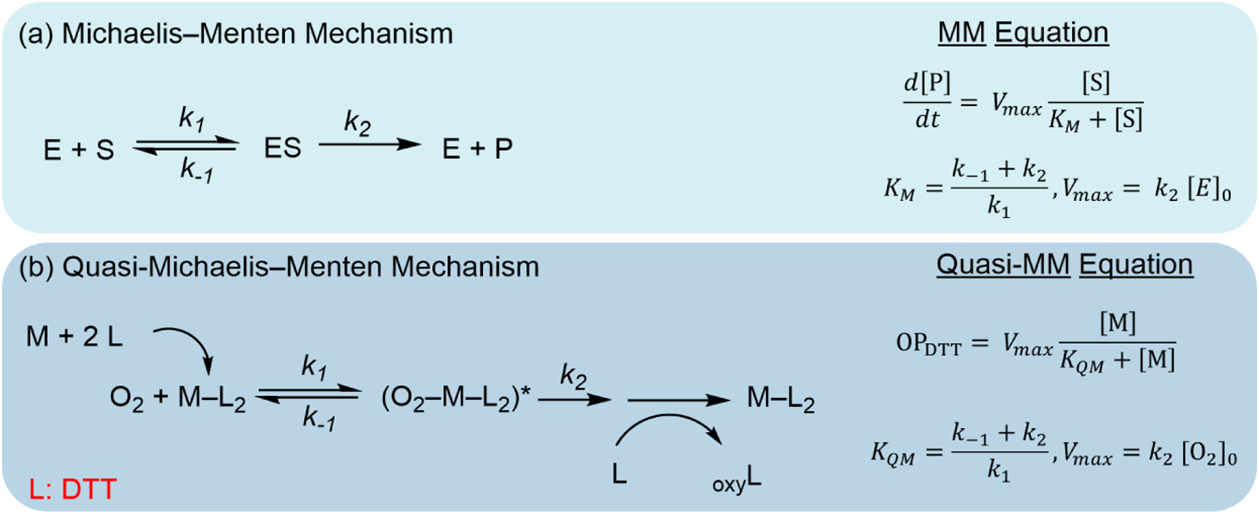
Transition metals (such as Cu2+ and Mn2+) first complex with DTT, followed by electron transfer and subsequent reaction with dissolved oxygen, reaching a kinetic bottleneck at higher metal concentrations.
2. Different OP Assays
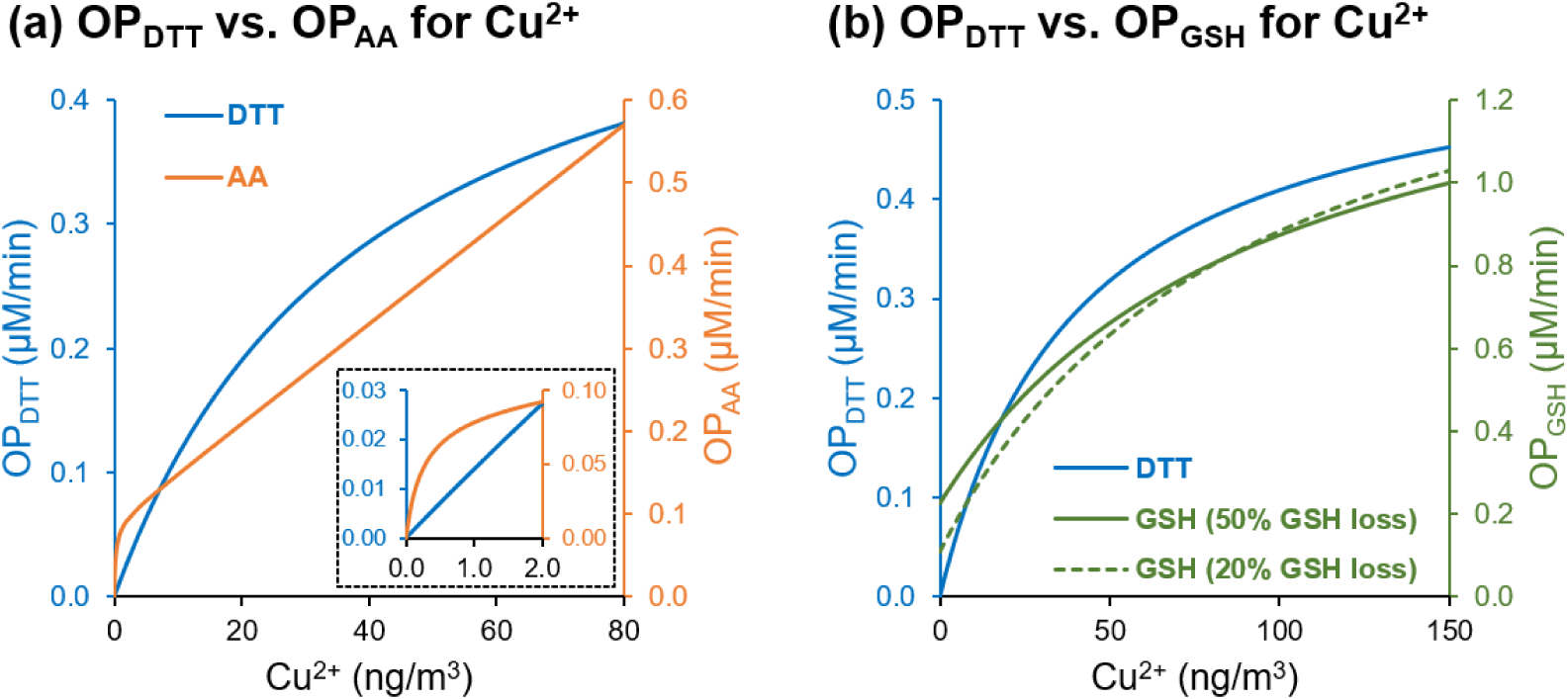
In addition to DTT, researchers frequently employ Ascorbic Acid (AA) and Glutathione (GSH) assays. However, these assays are not interchangeable "rulers". Comparative analysis shows that:
- The AA system exhibits an additional direct oxidation pathway.
- The consumption rate in the GSH system is more sensitive to the remaining GSH concentration.
- In contrast, the DTT consumption rate remains approximately constant over the designated reaction time window.
Consequently, discrepancies among these assays stem from the fundamental differences in the specific chemical reaction pathways they target.
3. Antagonism and Real-World PM Validation
- Metal-Metal Antagonism: When Cu2+ and Mn2+ coexist, they compete for shared oxygen-dependent reaction steps, resulting in an antagonistic effect where the combined OP response is lower than the sum of individual contributions.
- Organic Contribution: In ambient PM2.5 samples, Cu and Mn account for approximately 68% of the observed OPDTT while the remaining fraction strongly correlates with Water-Soluble Organic Carbon (WSOC).
- Comprehensive Model: Combining the nonlinear metal interaction model with an empirical WSOC term accurately reproduces 98.6% of the measured OPDTT in ambient samples.
Conclusion & Implications
The Quasi-Michaelis–Menten framework provides a robust chemical kinetics foundation for quantitative OP normalisation, inter-method comparison, and accurate chemical-composition-based OP modelling. Key takeaways for future atmospheric toxicology and environmental chemistry research include:
- Correction for Sample Loading is Mandatory: A lower measured OPm at higher mass loading reflects chemical saturation rather than lower intrinsic particle toxicity. Sample loading normalization is essential when comparing OP across different studies or regions.
- Linear Receptor Models Need Revision: Traditional source apportionment models (such as PMF) assuming linear additivity neglect saturation and component interactions (e.g., metal antagonism), potentially distorting health risk allocations.
- Strict Experimental Quality Control: Trace metal impurities in buffers can alter background kinetics; simple blank subtraction may not fully eliminate systematic errors due to nonlinear baseline shifts.
- Bridging Acellular Assays & Health Risks: Unraveling the true chemical kinetics of acellular assays is a fundamental step toward reliably connecting chemical toxicity metrics to real-world biological and health outcomes.